Can You Solve This IQ Test? The Math Puzzle Explained
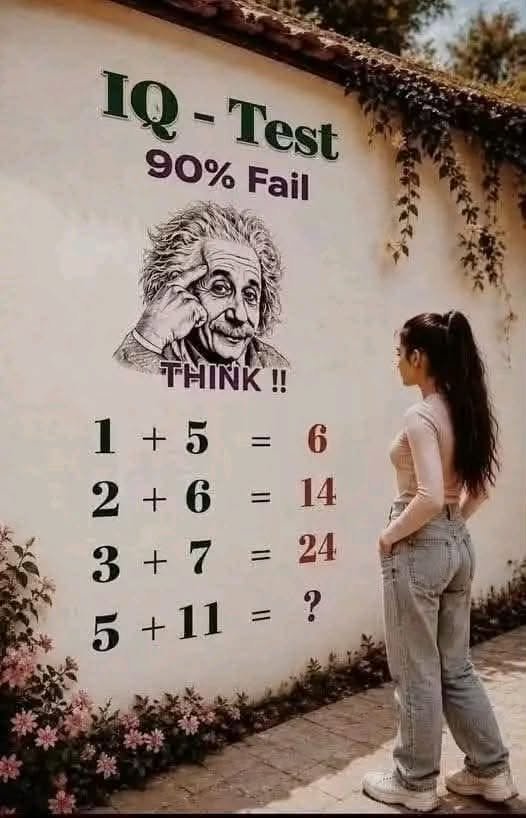
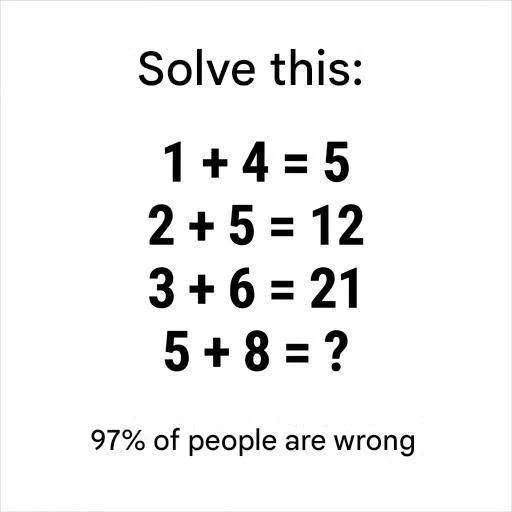
The image above shows a wall with a math puzzle painted on it. A woman stands in front of the wall, looking at the equations. The puzzle is labeled “IQ Test” and claims that 90 percent of people fail it. The equations are:
1 + 5 = 6 2 + 6 = 14 3 + 7 = 24 5 + 11 = ?
At first glance, the first equation seems normal. But the second and third equations do not follow standard addition. This means there is a hidden pattern. Let us find the rule that makes these equations work.
Finding the Pattern
Let us look at the first three equations and see if we can find a consistent rule.
For the first line: 1 + 5 = 6. This works with normal addition, but it also works with another rule. If we multiply the two numbers and add the first number, we get: 1 x 5 + 1 = 6. This works.
For the second line: 2 + 6 = 14. Let us test the same rule: 2 x 6 + 2 = 14. This works.
For the third line: 3 + 7 = 24. Let us test it: 3 x 7 + 3 = 24. This works.
So the rule is: multiply the two numbers, then add the first number.
Applying the Rule to the Final Equation
Now we apply the rule to the final equation: 5 + 11 = ?
Multiply the two numbers: 5 x 11 = 55.
Add the first number: 55 + 5 = 60.
So the answer is 60.
Another Way to Look at It
Some people solve this using a different pattern. They add the previous answer to the current sum. Let us test this.
First line: 1 + 5 = 6.
Second line: 2 + 6 = 8. Add the previous answer (6): 8 + 6 = 14. This works.
Third line: 3 + 7 = 10. Add the previous answer (14): 10 + 14 = 24. This works.
Final line: 5 + 11 = 16. Add the previous answer (24): 16 + 24 = 40.
Using this method, the answer is 40.
Which Answer Is Correct?
Both 60 and 40 can be considered correct depending on which pattern you follow. This is what makes these puzzles tricky. They rely on ambiguous rules, and there can be more than one valid answer. The important thing is that you exercised your brain and had fun solving it.
Why These Puzzles Are Popular
Math puzzles like this are popular because they are simple, shareable, and encourage discussion. They remind us that math can be playful and that there is often more than one way to solve a problem.
So, what is your answer? 60 or 40? Share it with your friends and see what they come up with.