Can You Spot the Hidden Mistake in This Hospital Picture? Uncovering the Error in the AI-Generated Image
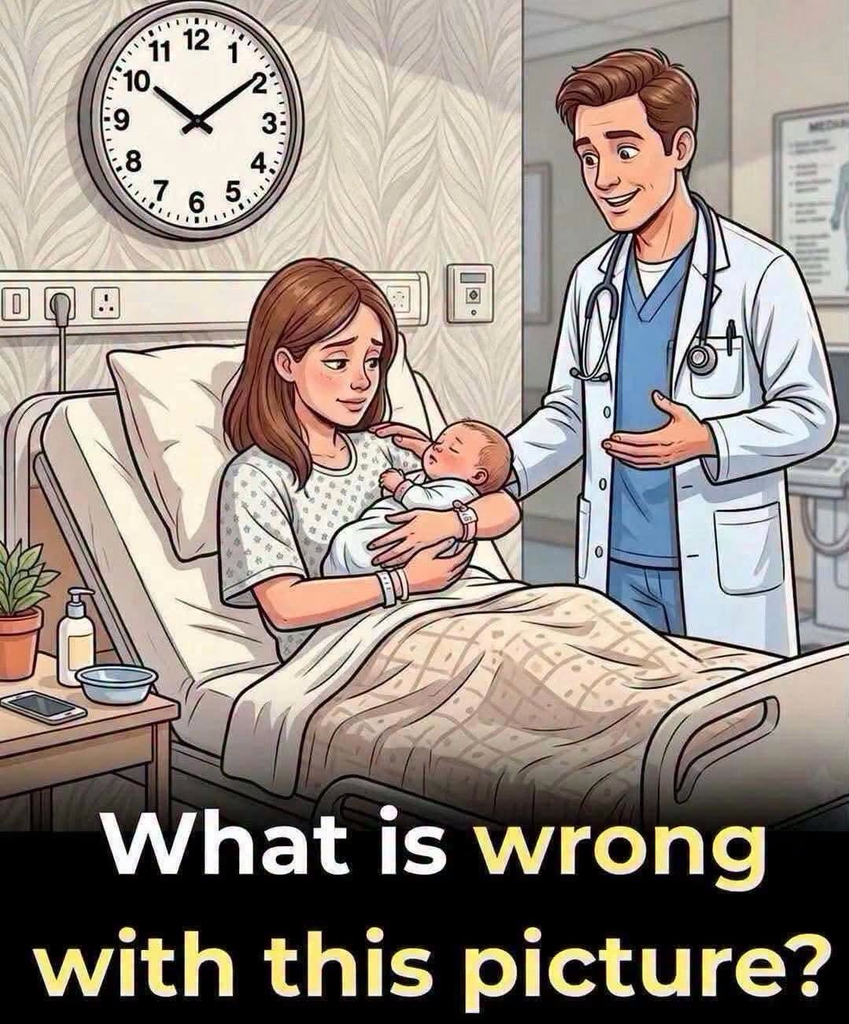
At first glance, the image appears to be a heartwarming scene: a new mother resting in a hospital bed, cradling her newborn baby, while a smiling doctor stands beside her. The room is filled with typical hospital details—a clock on the wall, medical equipment, a nightstand with a plant and a phone. The caption asks a simple but provocative question: “What is wrong with this picture?” The implication is that there is a hidden error, a mistake that reveals the image is not a genuine photograph but something else entirely.
The answer, once you see it, is impossible to unsee. The mistake is not in the medical equipment, the expressions on the faces, or the layout of the room. It is in the clock on the wall. The numbers on the clock face are arranged incorrectly. Instead of the standard sequence from 1 to 12, the numbers are jumbled, with the 1 and 2 appearing in the wrong positions, and the sequence following a nonsensical pattern. This is a classic telltale sign of an AI-generated image, where artificial intelligence has learned the general appearance of a clock but has failed to grasp the logical structure of its numbering.
The Telltale Signs of an AI-Generated Image
The jumbled clock is the most obvious error, but a closer inspection reveals several other inconsistencies that are common in images created by generative AI. Understanding these signs is becoming increasingly important as AI-generated content becomes more prevalent online.
The Clock Face
The clock in the image is the clearest giveaway. The numbers are not in the correct order. The “1” is where the “12” or “1” should be, but the “2” is placed next to it in a way that does not align with a real clock face. The hands of the clock are also positioned in a way that does not correspond to a specific time. This is a frequent error in AI images because the AI does not understand the functional logic of a clock; it only reproduces the visual pattern it has learned, often imperfectly.
The Medical Equipment
Look closely at the wall behind the bed. There are electrical outlets and medical gas outlets, but their arrangement and design are slightly off. The panel appears to have a random assortment of sockets and switches that do not match standard hospital room configurations. The wires and connections are also vague and undefined.
The Doctor’s Hands and Accessories
The doctor’s hands are a common weak point in AI-generated images. In this picture, the doctor’s left hand is gesturing towards the baby, but the fingers are slightly blurred and lack distinct joints. The stethoscope around his neck is another area of concern; the tubing and the earpieces are not clearly defined, and the way it hangs is not entirely natural.
The Baby and the Mother
The baby, while appearing realistic at a glance, has a slightly unnatural smoothness to its features. The mother’s hands, which are holding the baby, are also a point of interest. AI often struggles with hands, and while these are not grotesquely deformed, they lack the fine detail and realistic positioning of a real photograph.
Why AI Struggles with These Details
The reason AI makes these mistakes is rooted in how it works. Generative AI models are trained on vast datasets of images. They learn patterns—what a clock generally looks like, what a hospital room generally contains, what a doctor generally wears. However, they do not have an internal model of reality or logic. They do not “know” that a clock has twelve numbers in a specific order, or that a stethoscope has a specific functional design. They simply generate pixels that approximate the statistical patterns they have learned, and sometimes, those patterns break down in the details.
The “Uncanny Valley” Effect
This is also related to the “uncanny valley” effect. When an AI-generated image is close to reality but not quite perfect, it can feel unsettling. The jumbled clock, the slightly off medical equipment, and the vague hands all contribute to a sense that something is wrong, even if the viewer cannot immediately articulate what it is.
Conclusion
The hidden mistake in this hospital picture is the clock face, which has its numbers arranged in a nonsensical order. This error is a clear indication that the image is AI-generated, not a real photograph. By learning to spot these telltale signs—jumbled text, illogical details, and vague anatomical features—we can become more discerning consumers of visual media. In an age where AI can create highly convincing images, the ability to identify these subtle flaws is a valuable skill.
Frequently Asked Questions
What is wrong with the picture?
The clock on the wall has its numbers arranged incorrectly. The sequence is jumbled, which is a common error in AI-generated images.
Is this a real photograph?
No. The image is AI-generated. The jumbled clock is the most obvious sign, but there are other subtle inconsistencies in the medical equipment and the hands of the figures.
Why do AI images have these mistakes?
AI models learn visual patterns from large datasets but do not understand the logical rules of the real world. They can reproduce the general look of a clock but may fail to place the numbers in the correct order.
What are other common signs of AI-generated images?
Common signs include:
Text that is garbled or nonsensical
Hands with too many or too few fingers, or oddly shaped joints
Objects that blend into each other or have impossible geometry
Reflections and shadows that do not match the light source
Backgrounds that are vague or inconsistent
How can I tell if an image is AI-generated?
Look for the details. Check text, clocks, hands, and the consistency of the background. If something looks slightly “off” but you cannot immediately explain why, it may be AI-generated. Using reverse image search can also help determine the origin of an image.