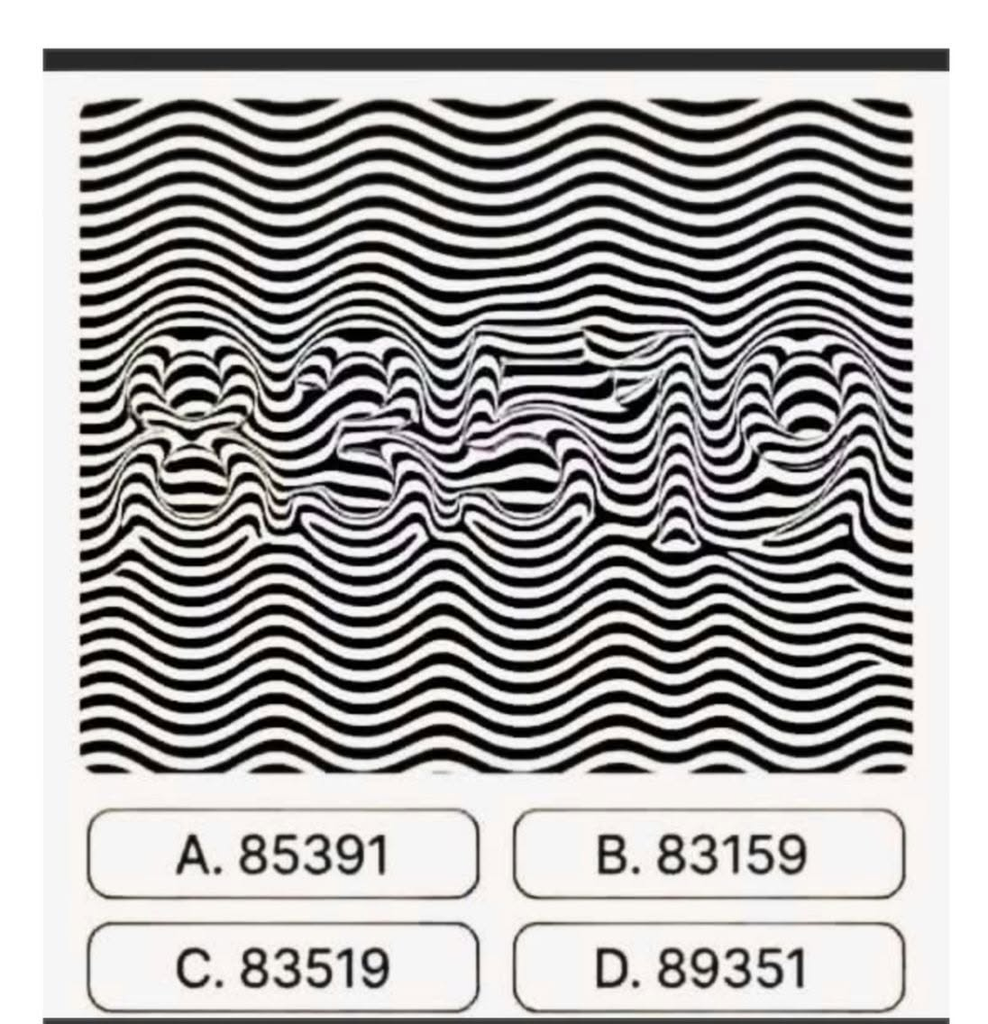
Optical Illusion Challenge: Can You Spot the Hidden Number in This Wavy Pattern?
Looking directly at the center of the image can sometimes make the hidden number harder to see. The wavy lines are designed to create a visual interference pattern, disrupting the edges and contours that our brains rely on to recognize shapes.
To find the number, try using a few simple visual tricks:
Squint your eyes: Blurring the image slightly can help reduce the distraction of the individual lines, allowing the larger shapes to emerge.
Move back from the screen: Viewing the image from a distance can help your brain connect the gaps and form the number.
Scroll the image up and down: Sometimes, the motion of moving the image helps the hidden shapes pop out from the background.
If you look closely at the center of the wavy pattern, the distorted lines begin to form the shapes of digits. The number hidden in the image is 83519.
The Science Behind the Illusion
This puzzle is a variation of a camouflage illusion, similar to the famous “Magic Eye” pictures that were popular in the 1990s. These illusions exploit the way our visual system works. Our brains are constantly trying to make sense of the world by grouping similar features together—a psychological principle known as the Gestalt laws of grouping.
In this image, the black and white waves are the background, and the numbers are created by subtly altering the thickness, curvature, and spacing of those lines. Because the contrast is low and the pattern is busy, our brains initially prioritize the continuous waves over the hidden digits. It is only when we consciously alter our focus—by squinting or moving back—that the “figure” emerges from the “ground.”
Why Do We Love Visual Puzzles?
Puzzles like this are incredibly popular on social media because they offer a quick, satisfying reward. When you finally see the hidden number, there is a sudden “aha!” moment—a release of tension and a feeling of accomplishment. This phenomenon is known as the Aha! experience, and it is linked to a surge of dopamine in the brain.
Furthermore, these puzzles are highly shareable. They create a sense of community as people debate the answer, offer tips on how to see it, and challenge their friends to try. It is a lighthearted, engaging way to interact with others online.
Beyond the Puzzle: The Real-World Benefits of Visual Acuity
While this specific puzzle is just for fun, the skills it tests—visual acuity, attention to detail, and pattern recognition—are valuable in everyday life.
Driving: Spotting a pedestrian in a busy street scene or reading a road sign in poor weather requires strong visual processing.
Reading: Recognizing letters and words quickly and accurately is a fundamental skill that relies on visual discrimination.
Safety: Noticing a small change in your environment, like a frayed wire or a spill on the floor, can prevent accidents.
By regularly engaging in puzzles and games that challenge your visual perception, you are essentially giving your brain a workout. It is a fun way to keep your mind sharp and your observational skills honed.
Conclusion
The wavy line optical illusion is a delightful reminder that our perception of the world is not always as straightforward as it seems. The hidden number, 83519, is a testament to the brain’s incredible ability to process complex visual information, even when it is disguised. Whether you solved the puzzle instantly or had to squint and step back to see it, the experience is a fun and rewarding challenge. The next time you come across a similar image, remember to relax your eyes, look at the bigger picture, and let your brain do the rest.
Frequently Asked Questions
What is the number hidden in the image? The number hidden in the wavy lines is 83519. This corresponds to option C in the multiple-choice list.
Why is it so hard to see the number at first? The image uses a camouflage technique where the digits are formed by subtle changes in the wavy lines. The busy pattern overwhelms the visual system, making it difficult for the brain to distinguish the number from the background.
What is an optical illusion? An optical illusion is a visual phenomenon where the image we perceive differs from the physical reality of the object. It occurs because our brains use shortcuts and assumptions to interpret visual data, which can sometimes lead to errors.
Do these puzzles have any health benefits? While they won’t cure any diseases, visual puzzles are a great way to stimulate the brain, improve focus, and practice pattern recognition. They are a fun mental workout.
How can I get better at solving optical illusions? Practice is key. The more you expose yourself to different types of visual puzzles, the more you train your brain to look for subtle cues and patterns. Learning to relax your focus and look at the “big picture” can also help.