Title: Can You Solve This Math Puzzle? The Equation That Is Stumping the Internet
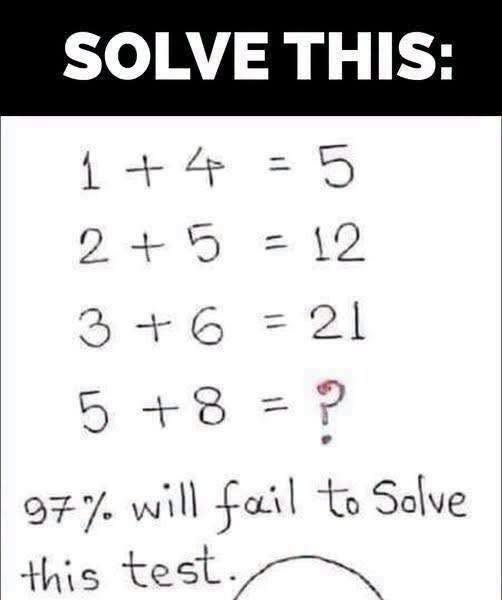
The image above presents a math puzzle that has been shared widely online. It shows a series of equations that do not follow standard addition rules. The text claims that 97 percent of people will fail to solve it. This is a classic brain teaser designed to test your pattern recognition skills. Let us break it down and find the solution.
The Puzzle
The equations are as follows:
1 + 4 = 5 2 + 5 = 12 3 + 6 = 21 5 + 8 = ?
At first glance, the first equation seems normal. But the second and third equations do not follow standard addition. This means there is a hidden pattern or rule that we need to discover.
Finding the Pattern
There are a few common ways to solve this type of puzzle. One popular method is to add the previous answer to the current equation. Let us test this theory.
Start with the first line: 1 + 4 = 5. This works normally.
For the second line: 2 + 5 = 7. Now add the previous answer (5) to this sum: 7 + 5 = 12. This matches the puzzle.
For the third line: 3 + 6 = 9. Add the previous answer (12) to this sum: 9 + 12 = 21. This also matches.
Now for the final line: 5 + 8 = 13. Add the previous answer (21) to this sum: 13 + 21 = 34.
So, using this pattern, the answer is 34.
Another Way to Look at It
Some people solve it using a different approach. They multiply the two numbers and then add the first number. Let us see how that works.
1 x 4 + 1 = 5 2 x 5 + 2 = 12 3 x 6 + 3 = 21 5 x 8 + 5 = 45
In this method, the answer is 45. Both 34 and 45 can be considered correct depending on which pattern you follow. This is what makes these puzzles so tricky. They rely on ambiguous rules, and there can be more than one valid answer.
Why Do People Get It Wrong?
The claim that 97 percent of people get it wrong is likely an exaggeration designed to grab attention. In reality, many people do solve it, but they may come up with different answers. The puzzle is less about math skills and more about recognizing patterns and thinking creatively.
The Bottom Line
Brain teasers like this are popular because they are simple, shareable, and encourage discussion. They remind us that math can be playful and that there is often more than one way to solve a problem. Whether you got 34, 45, or something else, the important thing is that you exercised your brain and had fun doing it.
So, what is your answer? Share it with your friends and see if they come up with the same result.