Your Nails Could Be Sending Warning Signs — Especially After 40
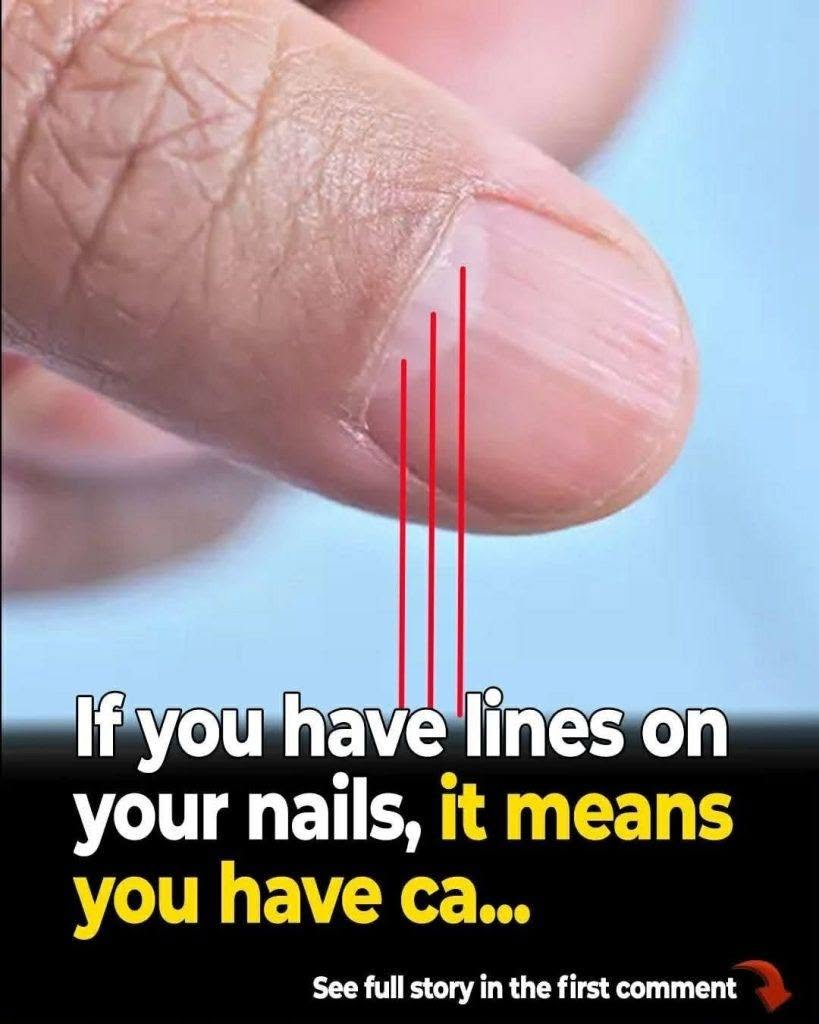
The image shows a close-up of a thumbnail with faint, parallel lines running across its surface, marked by a red arrow and paired with the caption, “If you have these lines on your nails after 40, it’s a clear sign that…” The sentence trails off, leaving the viewer to imagine the worst. It is a familiar tactic designed to provoke anxiety, and it often succeeds because nails are one of the few body parts we can examine closely every day.
The truth is more measured than the viral post suggests. Lines on the nails are common after 40, but they are not a single “clear sign” of one specific disease. They can be a normal part of aging, a reflection of nutritional status, or occasionally a clue to an underlying health condition that deserves attention. Understanding the difference between vertical ridges, horizontal grooves, and other nail changes is the key to knowing when to relax and when to seek medical advice.
The Two Types of Nail Lines: Vertical and Horizontal
The first step in interpreting nail lines is identifying their direction. Vertical ridges run from the cuticle to the tip of the nail. Horizontal lines, by contrast, run side to side across the nail. These two patterns have different causes and different implications.
Vertical Ridges: The Common Aging Change
Vertical ridges, medically known as onychorrhexis, are the most common type of nail line seen in adults over 40. They appear as fine, parallel furrows that extend lengthwise along the nail plate . For the vast majority of people, these ridges are a normal, harmless consequence of aging. As the nail matrix—the tissue beneath the cuticle where the nail is formed—undergoes age-related changes, the growth of the nail becomes slightly irregular, producing visible longitudinal lines .
A study cited in dermatological literature found that vertical nail ridges were present in 71 percent of people aged 50 or older who had no systemic or skin diseases and were not taking medication, while none of the people aged 20 to 30 had them . This strongly supports the conclusion that vertical ridges are primarily an age-related finding. The skin’s ability to retain moisture also declines with age, which can make the ridges more pronounced .
When vertical ridges are the only change—meaning the nail is otherwise normal in color, thickness, and texture—they are not a cause for concern. They do not indicate cancer, liver disease, or a shortened life expectancy. They are simply the nail equivalent of a wrinkle.
Horizontal Lines: Beau’s Lines and Their Meaning
Horizontal grooves or dents that run across the nail are a different matter. These are known as Beau’s lines, and they occur when something temporarily interrupts the growth of the nail matrix . Because the nail continues to grow outward from the cuticle, a horizontal line will gradually move toward the tip of the finger over several months.
Beau’s lines can be caused by a wide range of factors, including severe illness with high fever, major surgery, trauma to the nail, chemotherapy, and severe nutritional deficiencies such as zinc deficiency . They can also result from severe emotional stress or chronic conditions that interfere with blood flow to the nail matrix . When Beau’s lines appear, they are a sign that something disrupted the body’s normal processes weeks or months earlier. They are not a disease in themselves, but they can be a clue that an underlying issue needs attention .
Why the “After 40” Framing Matters
The viral post specifically targets people over 40, and there is a reason for that emphasis. The aging process produces predictable changes in the nails that begin to become noticeable around this age. According to dermatological research, after 40, fine longitudinal lines begin to appear, and the nail’s natural luster may diminish . By the 50s and 60s, nails often become thicker, more brittle, and more curved, and the aging features become more pronounced .
This does not mean that every nail change after 40 is automatically “normal aging.” It means that the baseline for what is expected shifts with age, and the context matters. A faint vertical ridge in a 50-year-old with no other symptoms is very different from a new, thick, dark line that is widening over time.
When Nail Changes Warrant Medical Attention
While most nail lines are benign, certain features should prompt a visit to a healthcare provider. The following signs are worth taking seriously.
A Dark Vertical Band That Is Changing
A single, dark vertical line—brown, black, or multicolored—that is new or changing is the most important nail finding to evaluate. Most dark lines beneath the nail are harmless pigment changes, but in rare cases, they can be a sign of subungual melanoma, a type of skin cancer . Warning features include a line that is unusually wide (occupying more than about a quarter of the nail’s width), contains multiple colors unevenly mixed, or is accompanied by splitting or deformity of the nail . Any new or changing dark band should be examined by a dermatologist.
Ridges Accompanied by Other Symptoms
If vertical or horizontal ridges are accompanied by other changes—such as thickening, yellowing, crumbling, separation of the nail from the nail bed, or pain—an underlying condition may be present. Fungal infections, psoriasis, and other skin conditions can cause these changes . Iron deficiency and thyroid disease have also been associated with nail changes, including brittle nails and prominent ridges .
Sudden or Widespread Changes
A sudden change in the appearance of multiple nails, especially if it is accompanied by systemic symptoms such as fatigue, unexplained weight loss, or fever, should be evaluated. While nail changes are rarely the first sign of a serious illness, they can sometimes be part of a broader clinical picture that a doctor can assess.
What You Can Do
For the common, age-related vertical ridges, no treatment is necessary. However, a few simple measures can support nail health. Keeping the hands and nails moisturized helps reduce the appearance of dryness-related ridges. Avoiding harsh nail products, such as acetone-based removers, and minimizing trauma to the nails can prevent additional irritation . A balanced diet that includes adequate protein, iron, zinc, and biotin supports normal nail growth .
If you are concerned about a specific nail change, the most reliable course of action is to show it to a healthcare provider. A dermatologist can examine the nail under magnification and, if necessary, perform further testing to determine the cause.
Conclusion
The lines on your nails after 40 are usually not a dramatic warning sign. Vertical ridges are a common, harmless feature of aging, present in the majority of older adults without any underlying disease. Horizontal Beau’s lines tell a different story—one of a past interruption in nail growth—but they too are not inherently dangerous and often resolve as the nail grows out. The nail changes that truly warrant attention are the ones that are new, changing, dark, or accompanied by other symptoms. The viral post’s ominous framing obscures this nuance, but the reality is more reassuring: your nails can offer useful clues, but they are not a crystal ball, and the most sensible response is informed awareness rather than fear.
Frequently Asked Questions
Do vertical lines on nails after 40 mean I have a serious disease?
No. Vertical ridges are a normal, common age-related change, found in the majority of people over 50 without any underlying disease . They are not a sign of cancer or a shortened life expectancy.
What causes horizontal lines on nails?
Horizontal lines, called Beau’s lines, occur when nail growth is temporarily interrupted by illness, injury, severe stress, or nutritional deficiency . They grow out with the nail over time.
Can nail lines indicate a vitamin deficiency?
Yes, in some cases. Severe zinc deficiency and protein deficiency can cause Beau’s lines . Iron deficiency has been associated with brittle nails and prominent ridges . However, most age-related vertical ridges are not caused by deficiency.
When should I see a doctor about a nail line?
See a doctor if you notice a new dark vertical band that is widening or changing color, if the ridges are accompanied by thickening, yellowing, or crumbling of the nail, or if the changes are sudden and affect multiple nails .
Can I get rid of vertical nail ridges?
Vertical ridges cannot be eliminated, as they are a structural change related to aging. Moisturizing the nails and cuticles can reduce dryness and make them less noticeable. Avoiding harsh nail products and trauma can prevent them from becoming more pronounced .