When This “Snake” Enters Your House, It Means You Have… A Harmless Lizard, Not a Venomous Serpent
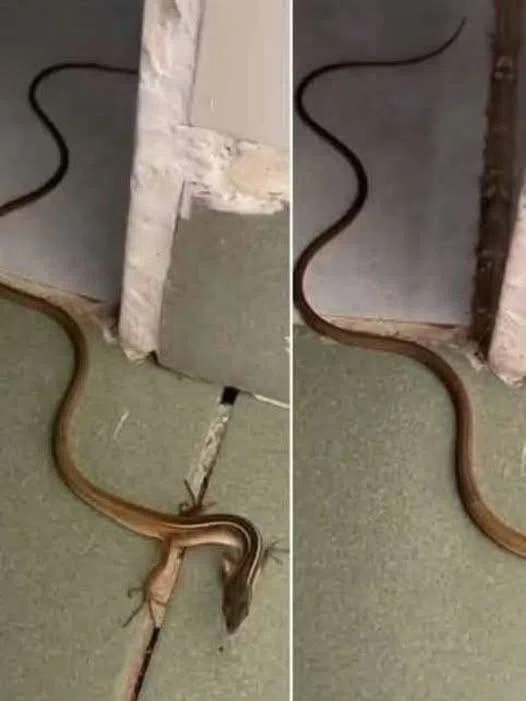
The confusion is entirely understandable. The creature possesses a body that is elongated and slender, and its legs are relatively small and held close to the body, making them easy to overlook at a glance . The most deceptive feature, however, is the tail. In some species of long-tailed lizards, the tail can be three or even four times the length of the body . When the animal is moving quickly across a floor or through grass, the body and tail form one continuous, undulating line that mimics the movement of a snake.
The “Snake with Legs” Phenomenon
The viral nature of this specific image stems from the shock of seeing what appears to be a snake that suddenly reveals tiny legs. Online commenters have described it as a “snake with legs” or a creature that looks like it belongs in a fantasy novel . The mouth and head, however, give away its true identity. The head is more angular and lizard-like than a snake’s, and the presence of small, clawed feet—even if they are hard to see—confirms that it is a lizard . The long tail is a defense mechanism: if a predator grabs the tail, the lizard can shed it (a process called autotomy) and escape, later regenerating a new, albeit shorter, tail .
The Most Likely Culprit: The Six-Lined Racerunner or Grass Lizard